

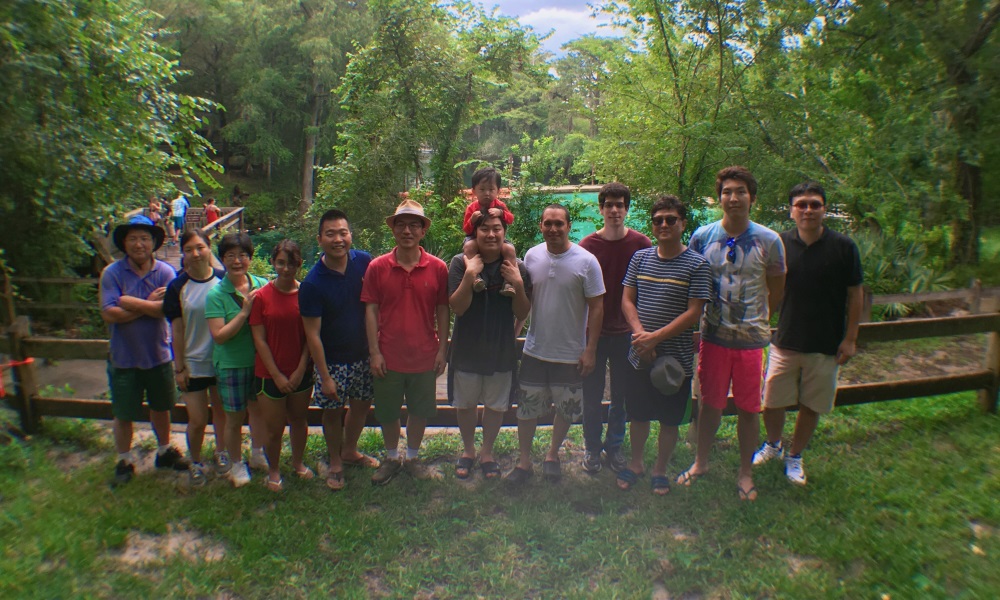
Prof. YK Yoon's Multidisciplinary nano and Microsystems (MnM) laboratory pursues research activities intersecting more than one traditional science and engineering discipline in nano and micro scale systems. Its research interests include nano/ microelectromechanical systems (MEMS) in radio frequency (RF) engineering, bio medical / microfluidic systems, optical and photonic applications, organic/ inorganic nano materials, and nano composites.
|
|
|
|
|
|
|
|
MnM Lab's 'United we Stand' on the front page of Lab on a Chip. Prof. YK Yoon and his student JK Kim wins Art in Science Award at the microTAS conference at Jeju Island, Korea this March 2009. The award winning "United We Stand" picture is published on the cover of Lab on a Chip journal 2010 Vol. 10. |
David Senior will defend his proposal "Micromachined Metamaterial Circuits for Microwave Applications" at 2:00 PM on Thursday August 25th in Larsen 234. Refreshments will be provided.
Dr. David Arnold and Dr. YK Yoon co-authored a chapter on metal deposition processes in the recently published MEMS Materials and Processes Handbook. With contributions from 35 industrial and academic MEMS researchers worldwide, the handbook provides a comprehensive reference for new materials, known materials, and specific processes for MEMS fabrication.
On Friday, March 25th, some IMG undergraduates will present their work at the Undergraduate Research Symposium in the Reitz Grand Ballroom. Two poster sessions are scheduled for 9-11am and 3-5pm, with oral presentations 1-3pm. The presentation schedule is attached; please come out and show your support for the IMG undergraduates!
Xiaoyu Cheng's paper will receive an honorable mention in Student Paper Competition of the 2011 IEEE AP-S International Symposium on Antennas and Propagation to be held in Spokane, WA. Xiaoyu will be presented a stipend at the ceremony and his paper will be listed in the Technical Program Booklet as an honorable mention in the Competition.
ECE Seminar Series
Programmable Self-assembly for Heterogeneous Integration of Microsystems
Dr. Karl Böhringer, Professor
University of Washington
March 3, 2011
11:45 am - 12:45 pm
Larsen 234
Abstract
Self-assembly is the spontaneous and reversible organization of components into ordered structures, representing an alternative to the conventional manufacture of systems made of components from milli to nano scales. First commercial applications of self-assembly have appeared in recent years, for example in the fabrication of radio frequency identification tags. However, the full impact of this new approach towards hetero system integration will only be realized once self-assembly can be programmed on demand. This presentation gives an overview of several projects that aim at programmable self-assembly. A key concept is the “programmable surface” – an interface whose properties can be controlled with high spatial and temporal resolution. Several crucial topics are discussed: real time control of interfacial properties; optimization of binding site designs; and algorithms for the modeling and control of self-assembly. Promising novel manufacturing methods are emerging that combine the precision and reproducibility of semiconductor fabrication with the scalability and parallelism of stochastic self-assembly and with the specificity and programmability of biochemical processes.
Biography
Please note that this week's seminar is from 4PM (not 3PM) due to speaker's conflict.
Snacks and drinks will be served
Speaker: David Senior
Abstract: Highly compact metamaterial devices are demonstrated by combining the composite right-left handed transmission line approach with a multilayer surface micromachined fabrication processusing SU8 as a dielectric layer. Multiband microwave metamaterial applications for ISM frequencies of 2.4GHz and 5.8GHz are implemented The use of microfabrication techniques eliminates the necessity of using surface mounting device (SMD) based lumped components and makes the CRLH structures compatible and integrable with CMOS/MEMS processes while allowing batch fabrication of multiple devices.
Please note that this week's seminar is from 4PM (not 3PM) due to speaker's conflict.
Snacks and drinks will be served
Speaker: Cheolbok Kim
Abstract: Modern satellite communication systems often demand low-profile, wide bandwidth, high gain, and circular polarization antennas. For this applications, a high gain circular polarization antenna with metamaterial slabs has been proposed. Metamaterial slabs having periodic circular lattices have been used to focus beam while fan-shaped patches are added on the slabs to generate circular polarization. The proposed antenna has shown a good axial ratio at the resonant frequency band. It also has shown a simulated gain improvement and transmission gain improvement. In addition, the left/right handed polarization is simply controlled by turning over metamaterial slabs.
Speaker: PitFee Jao
The direction of cell growth is associated with chemical, structural and/or mechanical properties of the substrate. Structurally, electrospun nanofibers provide a suitable environment for cell attachment and proliferation due to their similar physical dimension to that of the extracellular matrix. Furthermore, by modulating the topographical features of nanofibers, which include fiber diameter and orientation, cell growth and its related functions can be modified. Here, we demonstrate a solid gradient scaffold for directional growth of spiral ganglion neurons (SGNs).
IMG welcomes Professor YK Yoon as new faculty in the Department of Electrical and Computer Engineering. Prof. Yoon joins IMG from the University of Buffalo, The State University of New York. He has achieved numerous awards for excellence including the NSF CAREER Award and the UB's Exceptional Scholar Young Investigator Award. His research interests include MEMS and nanotechnology, RF/Microwave, millimeter wave and terahertz system, Micro/nano-biomedical devices and bio molecule (drug/vaccine/gene) delivery, µ-TAS, lab-on-a-chip, wireless/wired sensors and actuators and Metamaterial and its RF application. Prof. Yoon is also the Director of the Multidisplinary Nano and Microsystems Laboratory at UF.
